

How updates are handled
How we keep UAE navigation information current
Navigation information ages quickly. This page explains how we review road changes, app updates, tolls and public-transport information — and how you can flag something that no longer matches reality.
What this page covers
We would rather tell you the limits of our process than imply a level of currency we cannot maintain. So here is the whole arrangement in plain terms: what we watch, how often we look, what we change when something moves, and what we simply cannot promise. Everything on this page is about our own editorial process, not about the apps themselves.
We follow documented changes to the tools we cover.
When a page changes, the substance changes with it.
Reader corrections go through our contact page.
Why navigation content goes stale
Navigation writing has a shorter shelf life than most editorial work. A feature comparison written last year may describe an app that has since changed its routing model. A road description may reference an interchange that has been rebuilt, renamed or bypassed by a new corridor. A toll note may still describe a gantry that now works differently.
That is not a reason to stop writing about the subject. It is a reason to be specific about what a page is describing and when it was last looked at. A guide that says plainly "this is what the documentation showed at the time of review" is more useful to a driver than one that sounds permanently true.
So the honest response is to describe documented features, explain trade-offs where they exist, and be clear about the date a page was last reviewed. Where a claim depends on a vendor's current documentation, we say so. Where something is our own judgement about how a tool behaves in practice, we say that too.
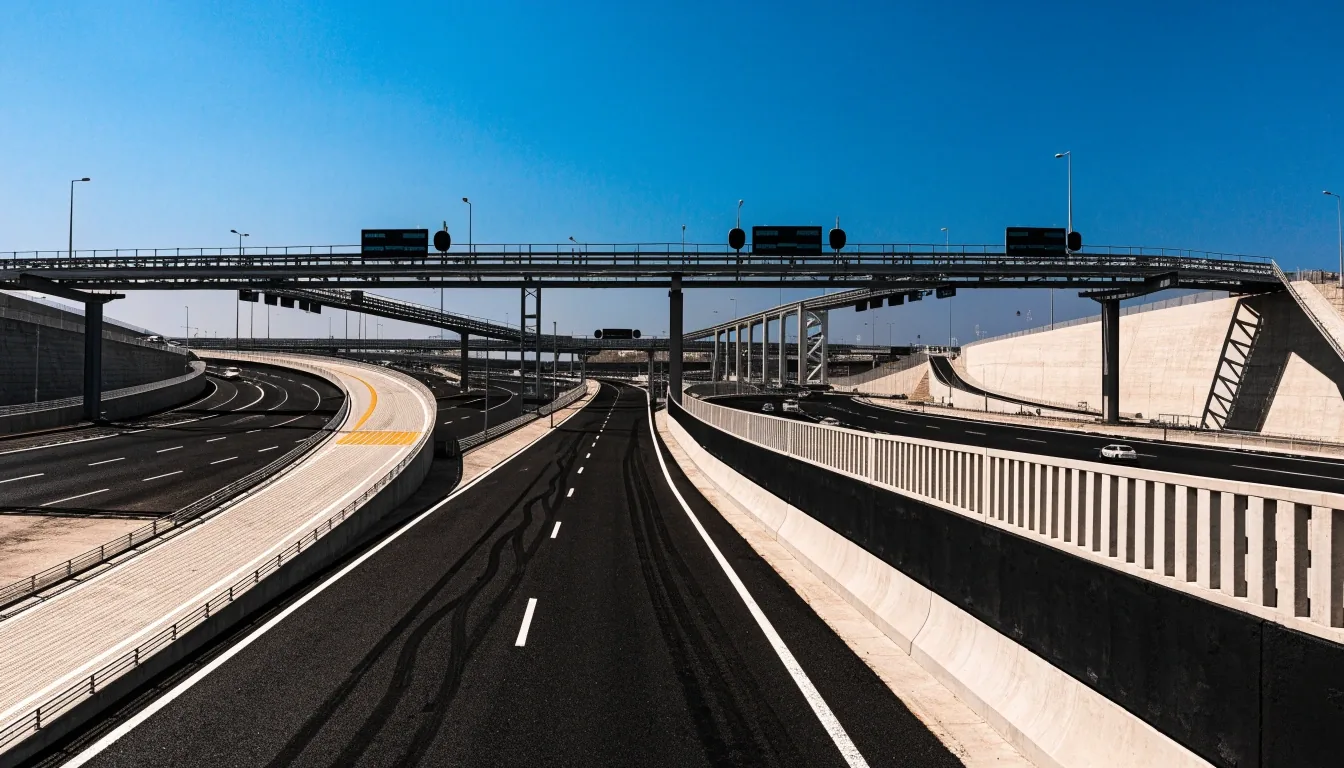
Interchanges get rebuilt faster than most pages get rewritten.
What ages fastest
- Turn-by-turn directions for a specific corridor.
- Claims that a feature exists only in one app.
- Toll and access rules written from memory.
Corridor descriptions and route types hold up much longer, which is why the guides lean that way.
What we monitor
We follow documented changes to the tools we cover, and to the official guidance that references them. This is a reading list of sources, not a live feed — and that distinction matters for how you should use the site.
2GIS offline maps and directory coverage
Which regions ship as downloadable packages, how often those packages are refreshed, and whether business listings inside a region are current enough to route to.
Offline layers
RTA Smart Drive features
Documented driver-facing functions, how the app describes its own coverage, and where the published description stops short of a driving feature.
Dubai roads
S'hail's scope
What the multimodal journey planner covers today, which modes it combines, and how far outside the emirates its published coverage extends.
Journey planning
Makani's integration with mapping services
How the official location system is used inside third-party navigation tools, and what that means when a building entrance is easier to find by its Makani number than by its street address.
Addressing
Official UAE mobility guidance
Published material that references these systems — speed policy, toll operation, public-transport information and inter-emirate route guidance. Where our wording and the official wording differ, theirs is the one to trust.
Policy
We do not attempt to monitor every roadworks project or live incident, because that is what live traffic apps are for. Our job is to explain how those features work and where their limits sit, not to report conditions minute by minute.
A guide should say when it was last checked
Every page here is reviewed on a rolling basis, with priority going to the topics where change is most likely.
How often pages are reviewed
There is no fixed calendar. Review effort follows likelihood of change, so the pages that can go out of date soonest get looked at first.
Reviewed most often
Comparison pages and feature guides
App features move, and a comparison built on a stale claim is worse than no comparison. These pages get the first look whenever a covered tool changes something a driver would notice.
Reviewed steadily
Practical guides and route explainers
Offline map guides, speed-limit explanations and inter-emirate trip notes change less often, but they still get checked when the underlying tool or policy shifts.
Reviewed when it moves
General explanations and this page
Background material about how a system works only needs updating when the system itself changes — or when the way we work changes, which is why this page exists at all.
When a page is reviewed and updated, the substance changes. We do not rewrite pages just to refresh a date, and we do not shuffle a paragraph to make a page look attended to.

Roadworks appear and disappear faster than any page can follow. We explain how apps handle them; the apps report where they are today.
How reader corrections are handled
Corrections from readers are one of our most useful inputs, particularly about local conditions. A driver who takes the same interchange twice a day knows things no documentation will tell you.
If you tell us a route description no longer matches reality, or that a feature has changed, we check it against current documentation and update the page where the change holds up. Submissions go through our contact page, and we read them.
Contact
Email [email protected] or call +971 4 587 8720. We are reachable Monday to Friday, 9:00 AM – 6:00 PM.
Office 2105, Al Sila Tower, Sheikh Zayed Road, Business Bay, Dubai, United Arab Emirates.
You tell us what changed
Which page, and what is wrong or out of date. Specifics help: a feature name, a road, a tool behaviour you have observed on a route you drive.
We check it against current documentation
If the published material confirms your correction, the page changes. If it does not, we say so rather than quietly leaving the old text standing as if it had been checked.
The copy is rewritten, not annotated
Readers want accurate information, not a changelog. When a correction changes the substance of a comparison, we revisit the surrounding sections too, since one change usually affects others.
We cannot act on every submission, and we will not pretend otherwise. We do read them, and they decide what gets reviewed next.
What we cannot verify
If a page here ever reads like a promise about performance, that is a problem, and we would want to fix it.
We cannot verify how any app will perform on your specific route on a specific morning. Traffic conditions, signal coverage, device behaviour and app decisions vary too much for a static page to describe honestly.
Not something we claim
That a given app will route you around a delay faster than another, or that a particular corridor is clear at a particular hour.
What we do instead
Describe documented features accurately, and explain where each tool's limits sit — offline coverage gaps, reporting thresholds, areas where live data is thinner.
This is also why the site never reports current conditions. Live traffic belongs to the apps that collect it, with all the freshness and all the error that implies. Our pages are about how those systems work, what they cover, and what they leave out.
Feature changes in navigation apps
Apps update frequently, and features that were exclusive to one tool sometimes appear in others a year or two later. Speed limit alerts are the obvious example: what once sat in a single app now shows up across several, sometimes with different thresholds and different levels of reliability.
When a feature becomes more widespread, we update the comparison rather than leaving an outdated claim standing. We describe what is documented now, not what was true when a page was first written — and where an app's own published material is vague about a feature, we say that instead of filling the gap with a guess.
The same applies to routing models. An app that once prioritised the shortest distance may now weight live conditions, tolls or fuel stops differently. That change matters more to a comparison than a new icon in the interface, so it is the kind of change we look for first.

Features migrate between apps faster than the comparisons that describe them.
Road changes in the UAE
UAE road networks change with new developments, interchanges and toll infrastructure. A junction that was a roundabout five years ago is a signalised crossing today; a service road that once connected two districts may now be severed by a new express lane.
For that reason we describe corridors and route types rather than turn-by-turn directions. Specific directions go stale fastest of all, and a driver following a written instruction from an outdated page is worse off than one reading the road and the signs.
For current routing, your app is the right source, and it will always be more current than we are. Our pages explain how to use it well: which modes to check before a long drive, what offline coverage to download before you lose signal, how to read a reroute when it happens mid-journey. Those are the parts a static page can still teach.
Where an official source describes a road or policy differently from the way we have written it, the official source wins. We would rather correct a page than defend a phrase.
Corrections we have made
When we correct something substantive, we change the copy rather than adding a note about the correction. What follows is a description of the kinds of changes we make, not a log of individual edits.
A feature that spread across apps
When speed limit alerts stopped being specific to one tool, the comparison changed from a single-app advantage to a shared capability with different thresholds. The surrounding notes on reliability were rewritten with it.
A route description that no longer matched the road
Where a reader told us an access point had moved, we replaced the specific instruction with a corridor description — the type of change that ages slower and is harder to get wrong.
A coverage claim that was too generous
If a tool's published scope turned out to be narrower than our wording suggested, the sentence was cut back to what the documentation actually supports.
A policy reference that had moved
Toll and speed policy wording gets revised from time to time. When that happens, we re-read the official text and adjust ours to match rather than paraphrasing from memory.
If a correction changes the substance of a comparison, we revisit the surrounding sections too, because one change often affects several claims at once.
How to flag an update
Use the contact page. Tell us which page and what is wrong or out of date. Specifics help: a feature name, a road, a tool behaviour you have observed yourself.
A correction that names the page and describes what changed is far easier to verify than a general note that something somewhere feels wrong. If you can point to the published documentation that supports your point, that shortens the process again.
What helps most in a report
- The page you were reading and the section that looked wrong.
- The road, interchange or tool the note refers to, named plainly.
- The behaviour you observed, and whether you saw it more than once.
- Any published source that supports the change, if you have one to hand.
We cannot act on every submission, but we read them and use them to decide what to review next.
Questions readers ask
The short answers to the things people write in about most often. If your question is not here, the FAQ page goes further.
Check the FAQ
How often is this site updated?
Pages are reviewed on a rolling basis, with priority for topics where change is most likely. Comparison and feature pages are reviewed more often than general explanations, and no page is rewritten simply to move a date forward.
Do you track live traffic or roadworks on this site?
No. Live conditions are what traffic apps are for. We cover how those features work, what they cover and where they are thin — rather than reporting current conditions ourselves.
How do I report outdated information?
Use the contact page and tell us which page and what has changed. Specific details — a road name, a feature, a behaviour you have seen — help us verify the point and update the page.
Do you change a page when an app updates?
When the change is documented and a driver would notice it, yes. When a release note mentions something with no visible effect on routing or coverage, we leave the page alone rather than rewriting it for the sake of activity.
Where to go next
If this page answered the question about our process, these are the pages that put the process to work.